
Blue Smoke Control System — How It Works
Hot-mix asphalt (HMA) plants across the country have long dealt with neighbor and local government complaints about blue smoke and odors. But a newer challenge for producers is the increasing likelihood that they will be required to meet upcoming state-level regulations for controlling blue smoke and volatile organic compounds (VOCs) at their plants. In fact, within the past two years, New York and Utah have both proposed such regulations.
Specifically, the New York State Department of Environmental Conservation’s air regulations (6 NYCRR Part 220 ) at hot-mix asphalt (HMA) plants will soon include Subpart 220-3 Blue Smoke Control, requiring control measures in these areas:
- Liquid asphalt storage tanks
- Hot-mix asphalt storage silos
- Pugmills/truck loadout/drag conveyors
Similarly, The Utah Division of Air Quality has proposed regulating VOC emissions from HMA plants as part of its Northern Wasatch Front (NWF) Ozone State Implementation Plan (SIP). This rule would require HMA plant operators to control both VOCs and blue smoke emissions in the production and loading of HMA and at asphalt storage tanks.
As regulations such as these become the new normal across the country, what’s the answer for asphalt producers?
What is Blue Smoke?
Blue smoke is actually tiny oil droplets that make up the blue haze people associate with the production and handling of hot-mix asphalt. It’s this blue haze that carries much of the characteristic asphalt odor. Blue smoke typically escapes from hot-mix asphalt during its handling — most often at transfer points and during silo filling and truck loading. The blue smoke, or the
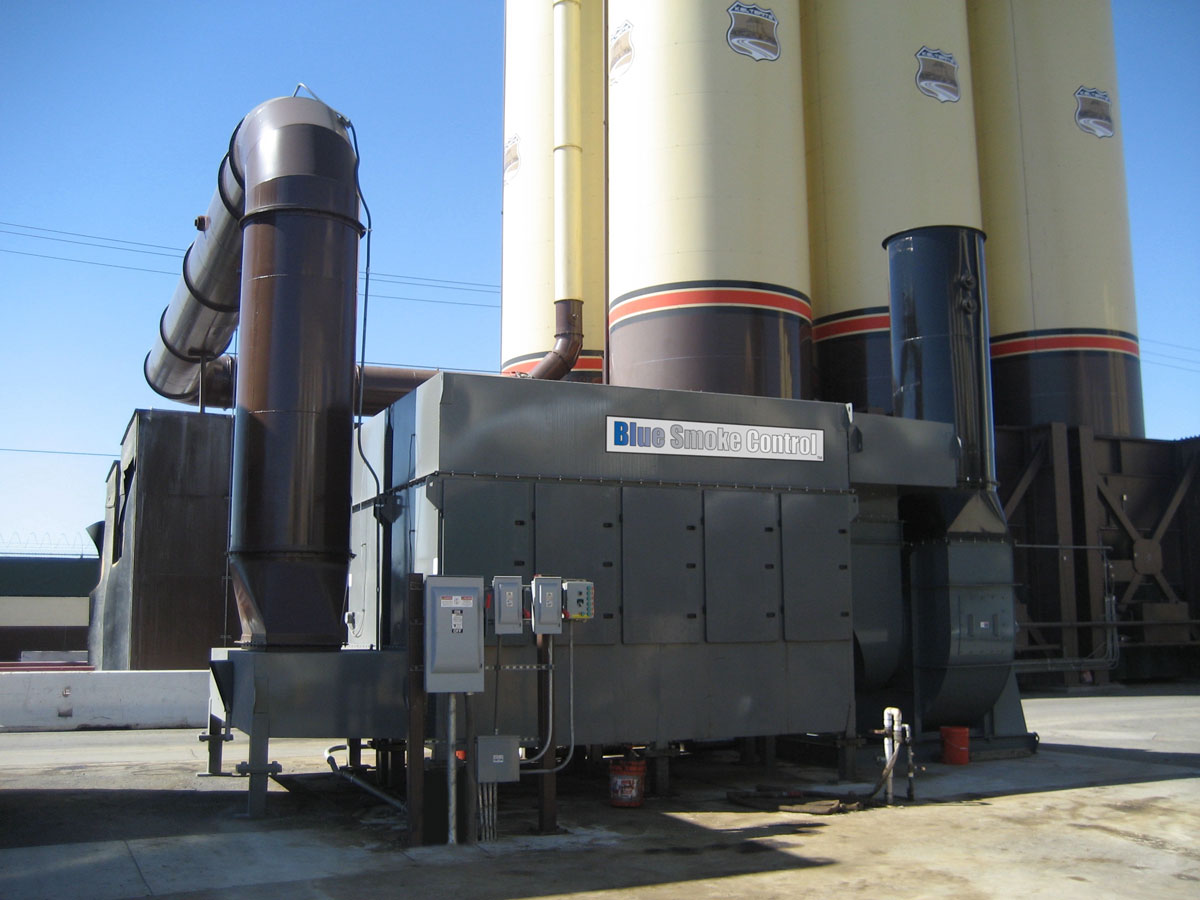
Blue smoke is actually tiny oil droplets that make up the blue haze people associate with the production and handling of hot-mix asphalt. It’s this blue haze that carries much of the characteristic asphalt odor.
tiny oil droplets, become airborne from hot asphalt much like steam rises from hot water. This blue smoke can be observed for brief periods as a rising plume.
Over the years, asphalt producers have fought blue smoke using a variety of filtering and collecting systems, such as electrostatic precipitators, HVAC-type filter units, baghouse-type devices with a bag-coating substance that resembles “kitty litter,” and a recycle system that directs the blue-smoke-laden air into the combustion zone of the asphalt plant burner. The intent of the latter method is to incinerate the oil droplets.
But each of these technologies has shortcomings that can create headaches of their own for producers — including their cost, efficiency, maintenance issues, waste disposal problems, and fire hazards.
Developing a Better Solution
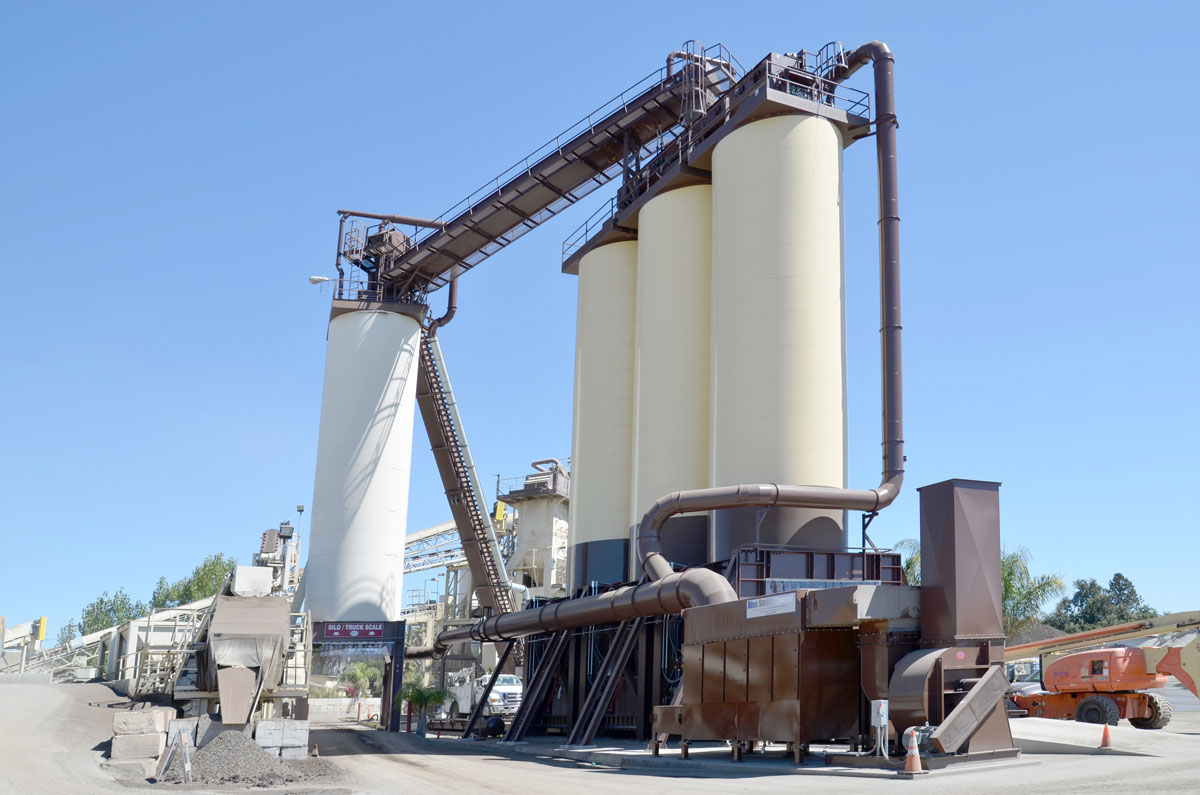
With the goal of finding a real solution, the Blue Smoke Control® division of Anaheim, California-based Butler-Justice, Inc., has developed a system to effectively and efficiently capture blue smoke from the numerous escape points that exist within hot-mix asphalt plants.
The patented Blue Smoke Control collector utilizes the principal of vertical air flow or “up-flow” to process the polluted air stream. Up-flow enables the collected oil to drip down into the system’s dirty air plenum, thus preventing the collected liquid from entering the clean-air stream.
The collector comprises seven stages of filtration, with the final high-efficiency filter being 95% efficient at capturing particles as small as .03 microns (creating a filter that is equivalent to HEPA quality). But this high-efficiency filter is only the final component of the system. Because blue smoke is a vapor at high temperatures, a well-engineered ducting system incorporates the infusion of ambient air at key points to help coalesce the tiny droplets of oil (the blue smoke) into larger droplets that can be filtered out by the Blue Smoke Collector. The coalesced oil is drained from the filters via gravity and collected in a sump. In some cases, the system can pull as much as five gallons of oil per day from conveyor transfer points, silo-filling spots, and truck load-out areas.
Because the filter cartridges sit vertically inside the collector, gravity aids the drainage process, resulting in highly efficient oil droplet collection, longer filter life, and easier maintenance. The Blue Smoke Control filter cartridge is made from proprietary filter media developed exclusively for Butler-Justice’s process of collecting oil mist. This media, combined with a special outer wrap, allows the filter cartridge to drain and prevents the collected liquid from entering the clean-air stream.
The complete system is 99.9 percent efficient overall.
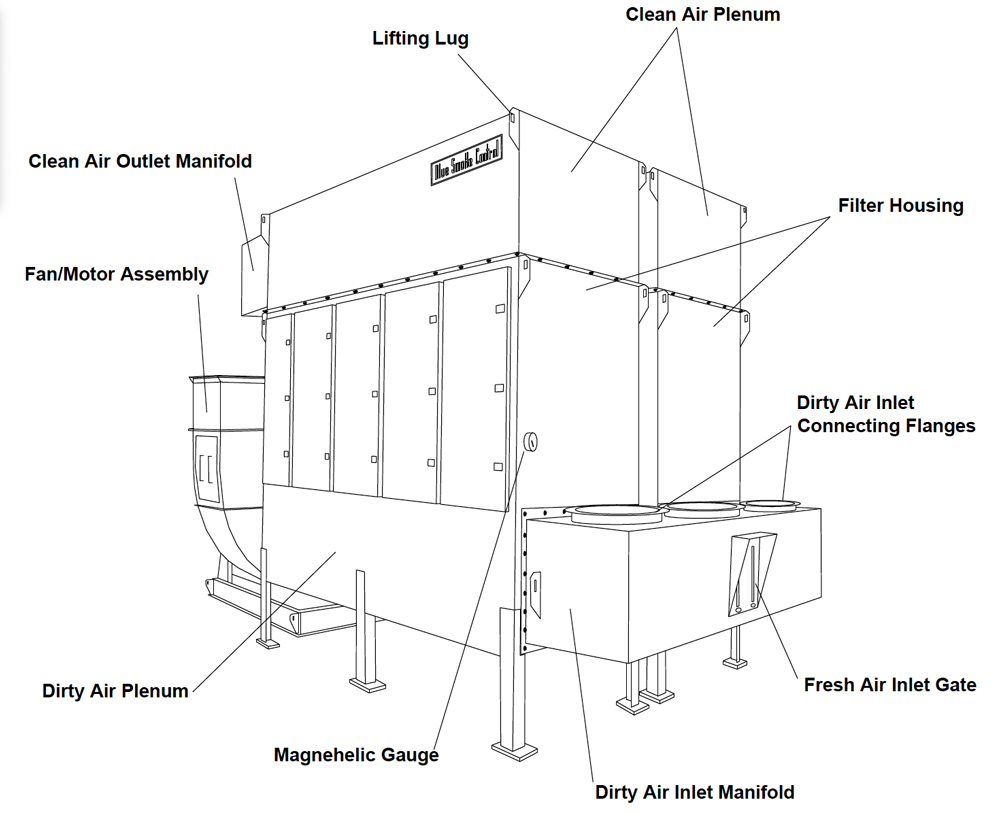
Figure 1
Blue Smoke Control System — How It Works
During normal operation, contaminated air enters the Blue Smoke Control collector through the dirty-air inlet manifold (see Figure 1).
The incoming air slows and turns upward, causing large oil mist droplets and particles to fall out of the air stream and settle in the dirty-air plenum (see Figure 2).
The air passes through the first three filter stages, which are designed to collect and coalesce large droplets and particles. The filters in the first three stages are reusable and may be cleaned periodically. The air that passes through these first three filter stages still contains smaller oil droplets.
A fourth-stage filter provides the next level of filtration. This stage is a disposable filter that should be replaced when it becomes full or plugged.
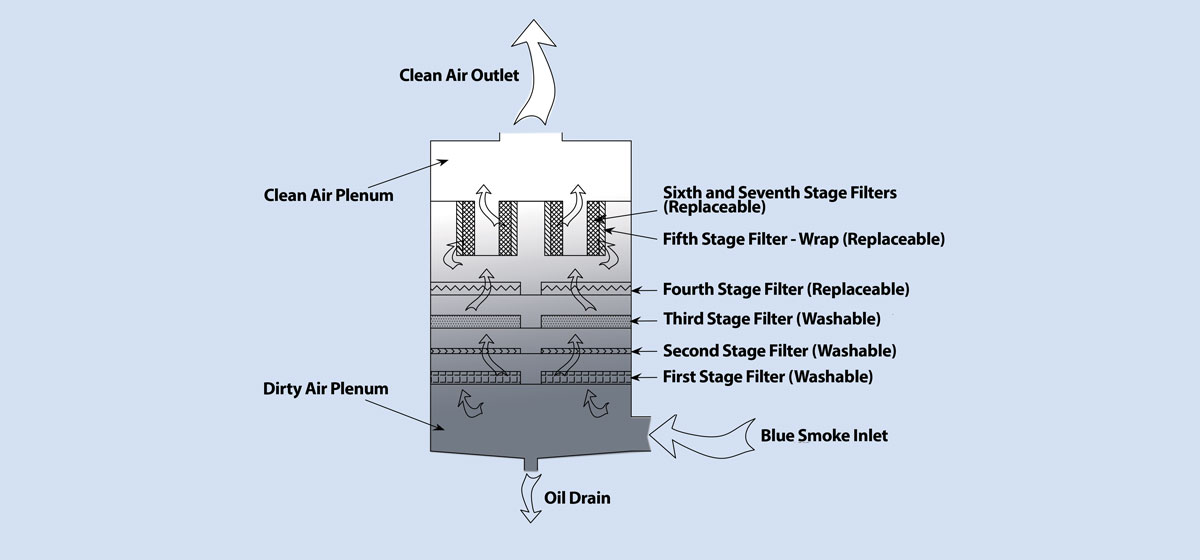
Figure 2
The fifth-stage filter is a “wrap” that wraps around the sixth- and seventh-stage cylindrical filters. This wrap collects and coalesces mist into larger droplets. The vertical orientation of the wrap promotes drainage of the droplets.
The air then passes through the cylindrical filter elements at the sixth and seventh stages of filtration. These filter elements and their six/seventh-stage filter inserts are the heart of the Blue Smoke Control system. These stages feature a pleated filter media that has been specifically designed to collect, coalesce, and drain fine oil mists. As oil droplets coalesce and form larger droplets, the droplets become large enough to run down the element and drain back into the collector. During normal operation, the droplets will drain on both the inside and outside of the filter element. Oil that collects on the inside of the element drains back into the collector due to the specially sloped design of the bottom filter pan. Clean, mist-free air exits the filter section and enters the clean-air plenum, exhausting out the clean-air plenum outlet.
The collected oil drains from the dirty-air plenum into buckets for disposal.
As with any pollution control device there is some pollutant that makes its way through the filter media. Even a 99% efficient filter allows 1% to get through. This efficiency concept means that in time, the clean air side of the collector, as well as the fan assembly, will become coated with oil — a normal occurrence.
The patented Blue Smoke Control collector utilizes the principal of vertical air flow or “up-flow” to process the polluted air stream. Up-flow enables the collected oil to drip down into the system’s dirty air plenum, thus preventing the collected liquid from entering the clean-air stream.
Efficiency in Emissions Control
Efficiency is a term that often is loosely tossed around without considering its ramifications. Strictly speaking, in order to clearly define efficiency for an emissions control project, it is necessary to measure and quantify the emissions at each source — with and without control equipment. Unfortunately, before installation of any control equipment, and because emissions are fugitive by nature, it is not practical to perform meaningful measuring and quantification. Moreover, as is true for all types of air pollution control equipment, actual system efficiency for each unique project cannot be specified until after the control equipment is installed and fully operational. (And at this stage in a permitting process, it may be a moot point.) Further complicating the issue is that efficiency can be defined as two types: collector or filter efficiency, and capture efficiency.
These types of efficiency issues have caused the Federal EPA, as well as many air pollution control agencies, to avoid the many concepts embroiled in the term “efficiency” and instead adopt stack emission standards for various processes.
Collector or Filter Efficiency
In the Blue Smoke Control system, the primary filter — or the final sixth/seventh stage of filtering — in the collector is accomplished via a cartridge filter with a high-efficiency Dryflo® filter media specifically designed for mist applications. The media is pleated and features Pleatloc™ media spacing, which enables the collected oil to drip off the filter and into the dirty air plenum for disposal as a liquid (see Figure 3). The media has been laboratory tested and assigned a control efficiency of 98% on mist droplets 1.8 micron and larger. Since most agencies treat blue smoke as a particulate, there is a tendency to define efficiency in terms of PM10 as though it were a true particulate. While the laboratory data indicates 98% on 1.8 micron and larger, it stands to reason that efficiency for larger particles, i.e. PM2.5 and PM10, will be significantly more efficient.
Incorporated into the primary filter is a replaceable insertable filter manufactured from proprietary materials. This filter has been laboratory tested to perform at a very high efficiency rating of 95% at 0.3 micron and larger.
Oil that collects on the inside of the element drains back into the collector due to the specially sloped design of the bottom filter pan. Clean, mist-free air exits the filter section and enters the clean-air plenum, exhausting out the clean-air plenum outlet.
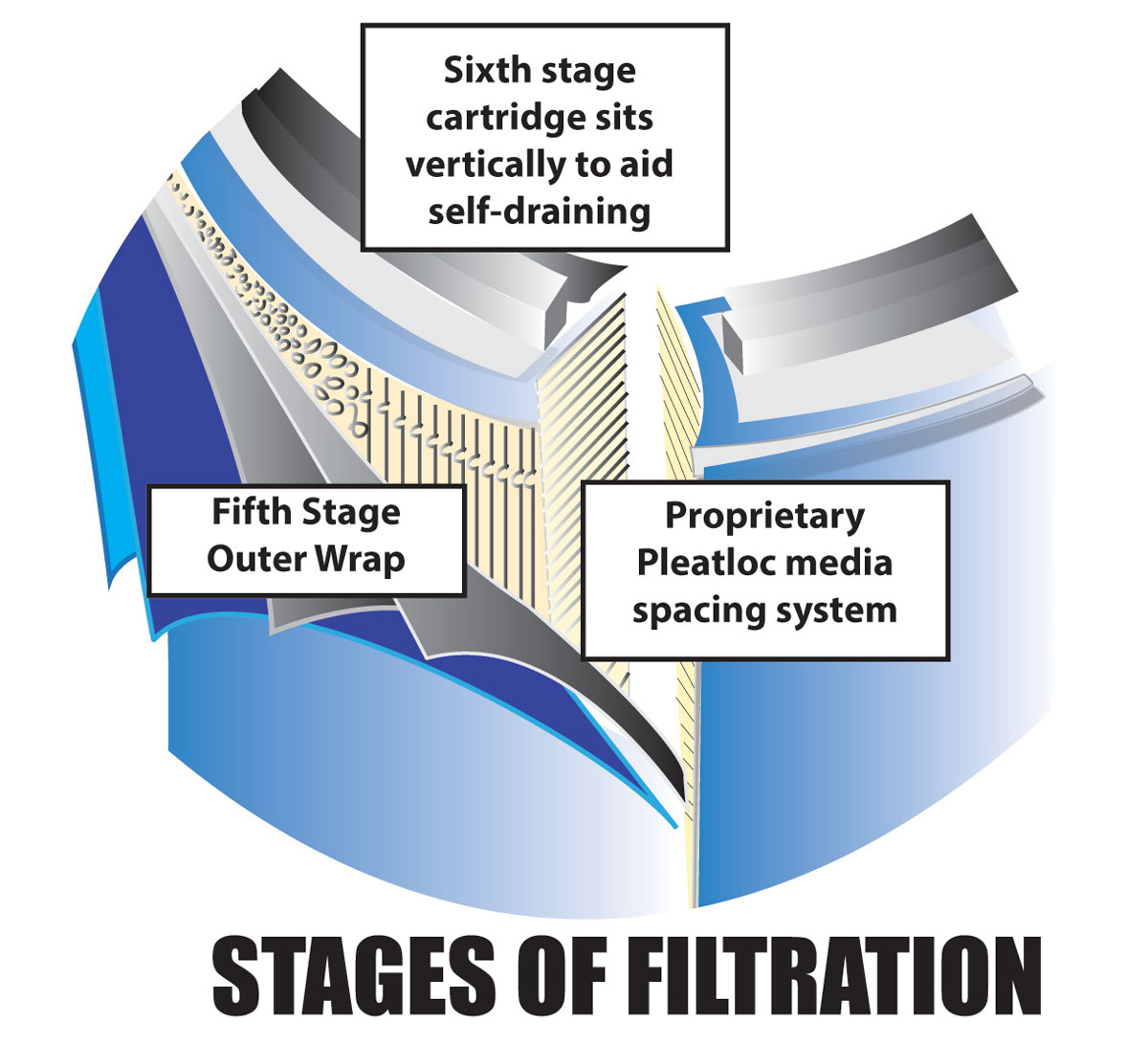
Figure 3
Oil that collects on the inside of the element drains back into the collector due to the specially sloped design of the bottom filter pan. Clean, mist-free air exits the filter section and enters the clean-air plenum, exhausting out the clean-air plenum outlet.
Capture Efficiency
Capture efficiency relates to the amount of exhaust air, as well as the design of hoods and enclosures within the plant. With the Blue Smoke Control system, Butler-Justice does not have control of the plant design and cannot vouch for the existence of properly sealed and flashed process equipment. Being involved in the design of blue smoke capture systems, however, allows Butler-Justice to routinely specify proper sealing and flashing as part of its Blue Smoke Control design parameters.
In a perfect environment, Butler-Justice designs for 100% capture efficiency in accordance with engineering standards, as illustrated in “Industrial Ventilation: A Manual of Recommended Practice” (a.k.a. the “Industrial Ventilation Manual”), as well as from field observations. Unfortunately, hot-mix asphalt material must be transferred between various pieces of process equipment, as well as loaded into on-highway haul trucks. Trucks entering and leaving the loading areas provide opportunity for minimal amounts of blue smoke to escape, especially as full trucks exit the loading area with hot asphalt.
It is for this reason that most agencies recognize no system can be 100% efficient. Therefore, it has become customary to assign either 80% or 90% capture efficiency. Field observations of the Blue Smoke Control systems engineered by Butler-Justice indicate that a well-designed blue smoke capture system can operate at 90% capture efficiency.
Easy Access, Easy Maintenance
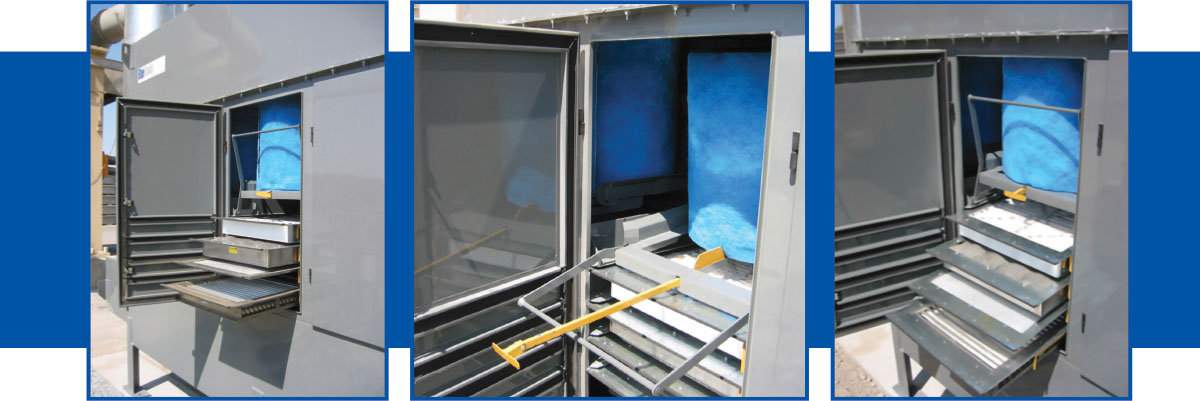
All stages of the Blue Smoke Control system’s filters are readily accessible through the filter access doors. Filters, or stages, are installed two-deep behind each door.
Each of the first four stages are readily accessible. The filter removal handle enables access to the back filter without reaching deep into the collector.
The fifth-, sixth-, and seventh-stage filters are accessible without reaching deep inside the collector. The filter removal handle enables the rear filter to be pulled out to access the opening for service.
The first three filter stages are all manufactured from metal, designed for long life with periodic cleaning. The cleaning frequency is a function of the amount of dust entrapped in the collected air. Stages four, five, and six/seven comprise disposable filters, which must be replaced when they become clogged. The life of these filters is a function of the amount of dust entrapped in the collected air. The operator should minimize the fugitive dust from haul roads and aggregate handling activities to assure long filter life and reduced operating costs.
In a perfect environment, Butler-Justice designs for 100% capture efficiency in accordance with engineering standards, as illustrated in “Industrial Ventilation: A Manual of Recommended Practice” (a.k.a. the “Industrial Ventilation Manual”), as well as from field observations.
Taking Odor Control to the Next Level
When it comes to alleviating complaints and meeting regulations, the capture and control of blue smoke at hot-mix asphalt plants is only part of the puzzle. Neighbors also complain about odors, even if there is no visible blue smoke. That is because while blue smoke does cause odors, it is not the only source of odors at hot-mix asphalt plants.
X-VOCS™ is Butler-Justice’s newest system for eradicating the odor-causing emissions produced as a byproduct during hot-mix asphalt production. Invisible emissions from plants — specifically, the odor-causing volatile organic compounds (VOCs) that reside in hot asphalt storage tanks — can create a number of additional challenges for producers.
Butler-Justice’s patent-pending X-VOCS System features proprietary carbon absorption technology designed to filter and remove up to 99 percent of odors and VOCs, such as Hydrogen Sulfide (H2S), from tanks. X-VOCS incorporates a five-stage filtration system. In the first three stages, a series of filters remove more than 95 percent of targeted particulates down to 0.3 microns. In the final two stages, carbon filtration beds remove remaining odors and volatiles.
Further, when the X-VOCS technology is coupled with the Blue Smoke Control system, emissions from hot-mix plants can be reduced to nearly zero.
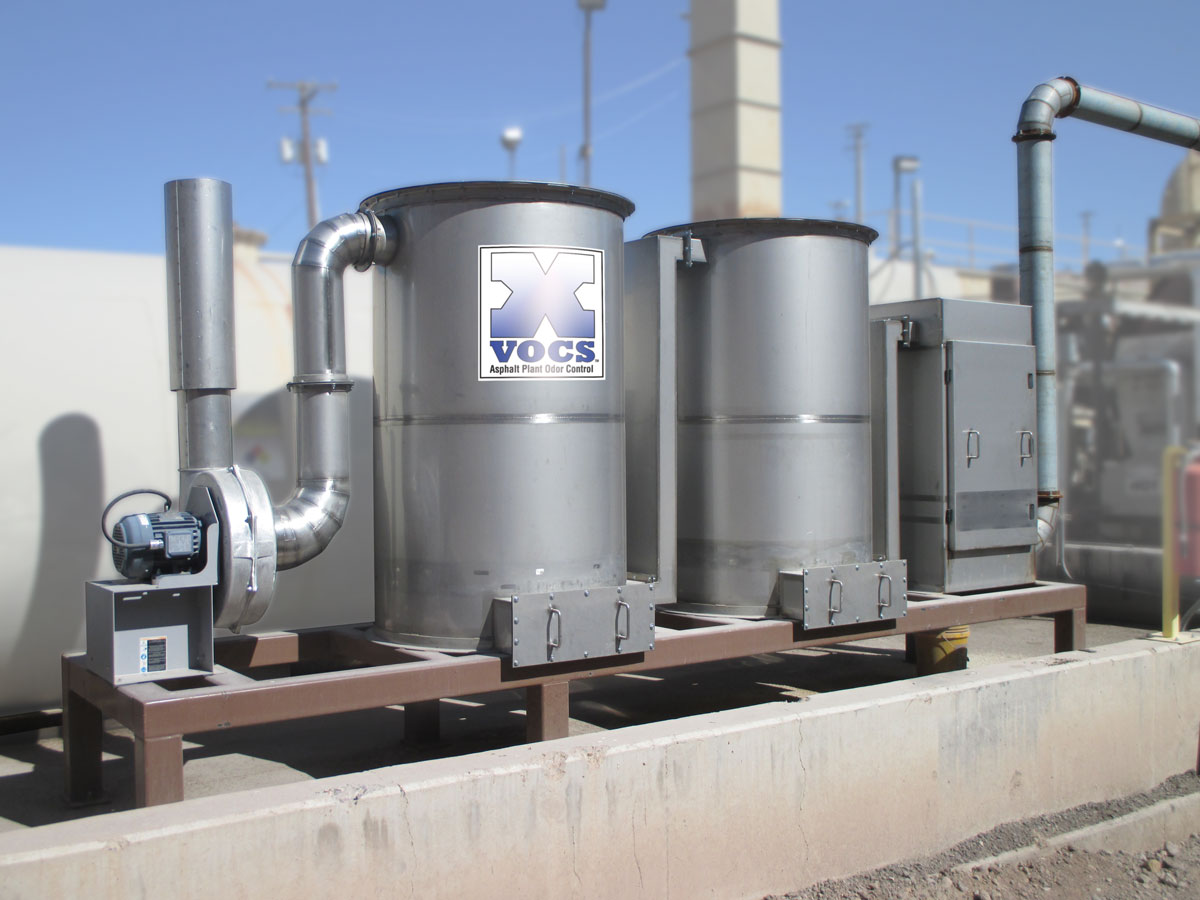
X-VOCS™ is Butler-Justice’s newest system for eradicating the odor-causing emissions produced as a byproduct during hot-mix asphalt production. Invisible emissions from plants — specifically, the odor-causing volatile organic compounds (VOCs) that reside in hot asphalt storage tanks — can create a number of additional challenges for producers. .
Conclusion
Both the Blue Smoke Control system and the X-VOCS system are ideal for new plants, and also are easily retrofittable into existing operations, with minimal modifications to the plant. By effectively and efficiently eliminating blue smoke and odor-causing VOCs at the plant, asphalt producers will be able to meet current and future regulations, reduce neighbor complaints, and ultimately achieve the highest level of environmental stewardship in the industry.
Technical Data — Third-Party Testing
In order to prove our claims of the effectiveness provided by the Blue Smoke Control system and X-VOCS, we turned to a third-party testing provider. Learn more about the results here.
Summary of Particulate Emissions -Outlet
Blue Smoke Control System
| Parameter |
Average gr/dscf |
Average lb/hr |
|---|---|---|
|
PM2.5 |
0.0004 |
0.02 |
|
PM10 |
0.0004 |
0.02 |
| Total |
0.0008 |
0.05 |
Summary of Control Efficiency
Blue Smoke Control System
|
Parameter |
Inlet lb/hr |
Outlet lb/hr |
Removal % |
|---|---|---|---|
|
PM2.5 |
2.53 |
0.02 |
99.2 |
|
PM10 |
0.28 |
0.02 |
93.1 |
| Total |
2.81 |
0.02 |
98.2 |
Summary of Results – Sulfur Compounds
X-VOCS System Emission Reduction Efficiency
| Compound |
Inlet |
Outlet |
Reduction Efficiency (%) |
|---|---|---|---|
|
Total Reduced Sulfer (ppbV) |
2,789 |
159 |
94.28% |
|
Hydrogen Sulfide (ppbV) |
1,367 |
154 |
88.77% |
Summary of Results – Selected VOCs
X-VOCS System Emission Reduction Efficiency
| Compound |
Inlet |
Outlet |
Reduction Efficiency (%) |
|---|---|---|---|
|
Benzene (ppbV) |
43 |
0 |
100.00% |
|
Ethylbenzene (ppbV) |
41 |
0 |
100.00% |
| Toluene (ppbV) | 154 | 17 | 89.15% |
| Xylenes (ppbv) | 291 | 37 | 87.34% |